Hotel booking in Ukraine in 2026 is less about thread count and more about a simple question: where will you go during an air raid alert, and how quickly can you get there? Many properties now advertise “shelter available,” but that phrase can cover everything from a properly prepared basement with lighting and seating to a basic storage room that is technically underground but uncomfortable, locked at night, or too small for the number of guests.
This shelter-first approach doesn’t mean you can’t have a beautiful trip. Kyiv, Lviv, Odesa, the Carpathians, and smaller cities are welcoming visitors again, with museums, cafés, and hotels operating in adapted conditions. It does mean your booking checklist should include access rules, backup power, and neighborhood logistics—especially if you arrive late, travel with children, or work remotely.
What “shelter available” really means—and how to confirm it before paying
On booking platforms, “shelter” is often a marketing tag rather than a standardized certification. Before you pay (or at least before your free-cancellation window closes), confirm what the hotel actually provides.
Understand the common shelter types
- On-site basement shelter (best-case): A designated underground area within the hotel building, accessible quickly from rooms and reception.
- Shared building shelter: The hotel is in a residential or mixed-use building and uses the building’s basement. Access may depend on building rules or a concierge.
- Nearby public shelter: The hotel directs guests to a municipal shelter, metro station, or underground passage within walking distance.
- “Basement available” (ambiguous): A basement exists, but it may not be prepared, may be locked, or may not be intended for guest use.
How to verify quickly (a practical sequence)
- Message the property in writing (platform chat or email) and ask for specifics (see the question list below). Written answers are useful if you need to change plans later.
- Ask for photos of the shelter entrance and the interior. A legitimate shelter area is usually easy for staff to photograph.
- Confirm the route: “From a standard room, how many minutes to reach the shelter?” If the answer is vague, press for a realistic estimate.
- Check if it’s on-site or off-site. Off-site shelters can still be acceptable, but you need to know the exact location and late-hour access.
- Ask how staff notify guests during alerts (front desk calls, intercom, app, hallway announcements). Some hotels rely on guests’ phone alerts only.
Red flags that justify choosing another hotel
- “Yes, we have a shelter” with no details and no willingness to share photos.
- Access depends on a single staff member being present, especially overnight.
- The shelter is described as “our basement corridor” with no mention of lighting, seating, or basic readiness.
- They suggest staying in the stairwell instead of a shelter as the default plan.
Questions to ask hotels: access hours, capacity, ventilation, water, Wi‑Fi, and backup power
These questions are designed to be copy-pasted into a booking message. They focus on what affects safety and comfort during an alert and during power interruptions.
Access rules (the non-negotiables)
- Is the shelter on-site? If not, where exactly is the nearest shelter you recommend?
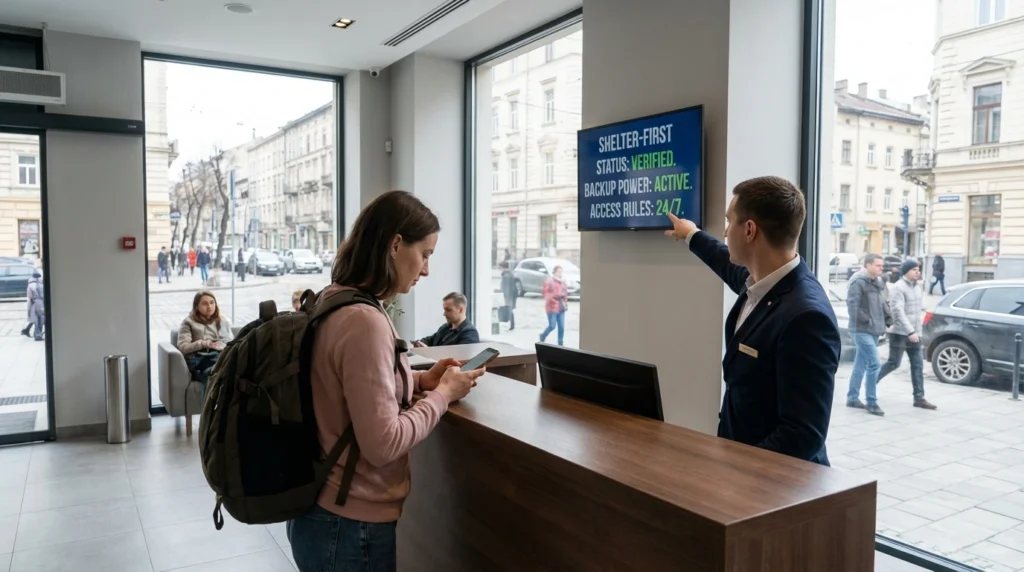
- Is shelter access 24/7? If there are restrictions, what are the hours and who unlocks it?
- How do guests enter at night? Key, code, staff escort, or open door?
- Can all guests use it? Some properties limit access to registered guests only; clarify if visitors or tour companions can join you.
Capacity and layout (avoid “standing-room only” surprises)
- What is the shelter’s approximate capacity? Ask for a number, not “enough.”
- Do you provide seating/mats/benches? If not, can guests bring a small mat or blanket?
- Is it accessible for children, seniors, or guests with limited mobility? Many basements have steep stairs; know this in advance.
Ventilation, sanitation, and water
- Is there ventilation? Mechanical ventilation, windows/vents, or none?
- Is there a restroom in or near the shelter? If not, what is the plan during long alerts?
- Is drinking water stored there? If not, can guests bring water down?
Connectivity and working remotely
- Is there mobile signal in the shelter? Basements vary widely.
- Is Wi‑Fi available in the shelter? If yes, is it the same network as rooms?
- Do you have a backup internet option? Some hotels use a secondary provider or a router on battery/UPS.
Backup power: what matters in real life
“Generator available” can mean anything from powering the lobby lights to running elevators and heating. Ask:
- Do you have a generator or battery backup (UPS)? Which areas are powered during outages?
- Does power cover room outlets? If not, is there a charging area in the lobby?
- Is the shelter lit during outages? Lighting in the shelter is a key comfort and safety factor.
- Do you have hot water during outages? If yes, for how long?
- Do elevators work on backup power? If not, plan for stairs—important with luggage or mobility needs.
A simple scoring method before you book
If you want a fast decision tool, rate each hotel from 0–2 on these five items: 24/7 access, on-site shelter, ventilation + restroom plan, backup power clarity, connectivity in shelter. A total of 8–10 is a strong shelter-first choice; 6–7 is workable if the neighborhood has good alternatives; below 6, keep searching.
Reading reviews for safety signals (not just comfort)
Many travelers still review hotels mainly for breakfast and cleanliness. In Ukraine in 2026, the most useful reviews mention how the property performs during alerts and interruptions. Your goal is to find consistent, specific details.
Keywords and phrases that usually indicate real preparedness
- “We went down to the basement during the alert; staff guided everyone.”
- “Shelter was clean / had chairs / had water / had Wi‑Fi.”
- “Generator worked; we could charge devices / had light in corridors.”
- “Clear instructions in the room / at reception.”
Signals that the “shelter” is more theoretical than practical
- “Basement was locked” or “we couldn’t find the entrance.”
- “Too crowded” repeated across multiple reviews.
- “No ventilation” or “felt unsafe/claustrophobic.”
- “Staff didn’t know what to do” during an alert.
How to judge review reliability
- Look for recency: prioritize reviews from the last few months, because staffing and procedures change.
- Prefer detailed narratives: “We stayed 4 nights, had two alerts…” is more useful than a one-line rating.
- Compare across platforms: if the same issues appear in multiple places, treat them as real.
Neighborhood selection: walking distance to metro/shelters and late-hour logistics
A well-prepared hotel is ideal, but neighborhood choice is your second safety layer. In many Ukrainian cities, being close to reliable underground options and having simple late-hour logistics reduces stress.
Prioritize walkability to underground options
- Metro access (where available): In cities with metro systems, proximity to a station can be valuable during alerts. Confirm the practical walking route, not just the distance on a map.
- Known public shelters: Some central districts have clearly marked municipal shelters; ask your hotel which ones they recommend.
- Terrain matters: Hills, icy winter sidewalks, or poorly lit streets can turn a “10-minute walk” into a difficult route at night.
Plan around curfew and late-hour movement
Curfew rules can vary by city and can be adjusted. For travelers, the practical takeaway is consistent: avoid itineraries that force you to cross the city late at night. When choosing a neighborhood:
- Stay near your evening plans: If you want restaurants, concerts, or winter markets, book accommodation within a short walk so you can return earlier without relying on transport.
- Check transport end times: Public transport often stops before curfew begins. Don’t assume you can “just take the metro back” late.
- Choose areas with 24/7 reception or self check-in: Late arrivals happen due to border queues and train delays; you need a clear entry procedure.
Late arrival checklist (especially for first-time visitors)
- Request step-by-step check-in instructions and confirm someone will be reachable by phone.
- Ask for the exact entrance (some buildings have multiple courtyards/doors).
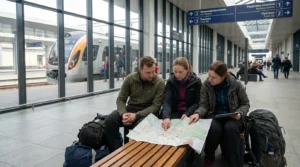
- Save offline maps and the hotel address in Ukrainian and English.
- Carry a small power bank and a headlamp/mini flashlight for stairwells and basements.
A shelter-first packing list for hotel stays
Even the best hotel shelter is more comfortable if you bring a few small items:
- Passport + a copy (paper or offline photo), plus local SIM details.
- Power bank and short charging cable.
- Small flashlight/headlamp.
- Water (a small bottle you can grab quickly).
- Warm layer (basements can be cold) and socks.
- Earplugs if you’re sensitive to noise in shared spaces.
A shelter-first booking strategy is not about fear—it’s about clarity. Once you know where you’ll go, how you’ll get in, and what works during outages, you can focus on the reasons you came: culture, food, landscapes, and meeting Ukrainians who keep daily life moving forward.
FAQs
Is “shelter available” on a hotel listing a guarantee of a proper shelter?
No. Treat it as a starting point. Confirm on-site vs nearby location, 24/7 access, and basic readiness (lighting, seating, ventilation) in writing before paying.
What’s the single most important shelter question to ask a hotel?
“Is the shelter accessible to guests 24/7, and how is it unlocked at night?” A good shelter is useless if you can’t enter it quickly.
How can I check backup power without technical knowledge?
Ask which exact areas remain powered during outages: room outlets, Wi‑Fi, heating, hot water, elevators, and shelter lighting. If they can’t answer clearly, assume limited coverage.
Are neighborhoods near metro stations always the best choice?
They can be convenient, but still verify your hotel’s on-site shelter and late-hour return route. A close metro station doesn’t help if your walking route is difficult or your hotel entry is complicated at night.
What should I do if a hotel refuses to share shelter details?
Choose another property. In 2026, hotels that are prepared usually provide straightforward answers and photos because guests ask these questions every day.