The landscape of Ukrainian travel has shifted significantly by 2026. While the architectural grandeur of Kyiv and the cobblestone charm of Lviv remain staples, a new wave of travelers is looking toward the horizon—specifically, the quiet, rolling hills and mountain ridges where Ukraine’s traditional soul resides. Village tourism, or green tourism, has become the cornerstone of authentic exploration. This movement prioritizes slow travel, allowing visitors to swap crowded museum queues for hands-on pottery workshops, farm-to-table meals, and the rhythmic pace of rural life.
Choosing a village destination in Ukraine requires a balance between cultural depth and practical accessibility. In 2026, the infrastructure connecting regional hubs to smaller settlements has seen marked improvement, making it easier than ever to reach the country’s hidden gems. Whether you are drawn to the intricate designs of Poltava ceramics or the rugged Hutsul traditions of the Carpathians, the Ukrainian countryside offers a profound connection to heritage that cities simply cannot replicate.
Top Village Destinations: Crafts, Nature, and Accessibility
When selecting a village for your 2026 itinerary, consider what kind of immersion you seek. For those fascinated by ancient crafts, Opishnia in the Poltava region is an essential stop. Known as the pottery capital of Ukraine, this village sits picturesquely on the banks of the Vorskla River. It is not merely a place where pots are made; it is a living laboratory of Ukrainian clay culture. The National Museum of Ukrainian Pottery here is a sprawling complex where you can view centuries of evolution in ceramic art. Reaching Opishnia is straightforward: it is roughly 50 kilometers from Poltava. Travelers can take a regular bus from the Poltava central station, which takes about an hour, or drive via the H12 highway in 45 minutes. The roads in this region are well-maintained, facilitating a smooth transition from the city to the quietude of the riverbanks.
If your heart is set on the mountains, Dzembronia stands as one of the most iconic high-altitude villages in the Ivano-Frankivsk region. This is the epicenter of Hutsul culture. Dzembronia has long been a sanctuary for artists and writers, famously inspiring the film ‘Shadows of Forgotten Ancestors.’ In 2026, it remains a premier destination for those who want to combine cultural immersion with physical activity. The village serves as a primary trailhead for hikes to Pip Ivan Chornohirsky, one of Ukraine’s highest peaks. While Dzembronia is more remote than Opishnia, the journey through the Verkhovyna district offers some of the most breathtaking vistas in the Carpathians. The effort to reach this ‘village in the clouds’ is rewarded with pristine air and a sense of timelessness.
Immersive Experiences: From Pottery Wheels to Mountain Trails
The beauty of Ukrainian village tourism lies in active participation. In Opishnia, the experience goes beyond observation. Many local artisans and the Institute of Ceramics offer workshops where visitors can sit at a traditional wheel. Creating your own ceramic piece—perhaps a small whistle or a bowl—provides a tangible link to the generations of masters who have worked this clay. These handmade souvenirs carry more weight than anything bought in a city gift shop.
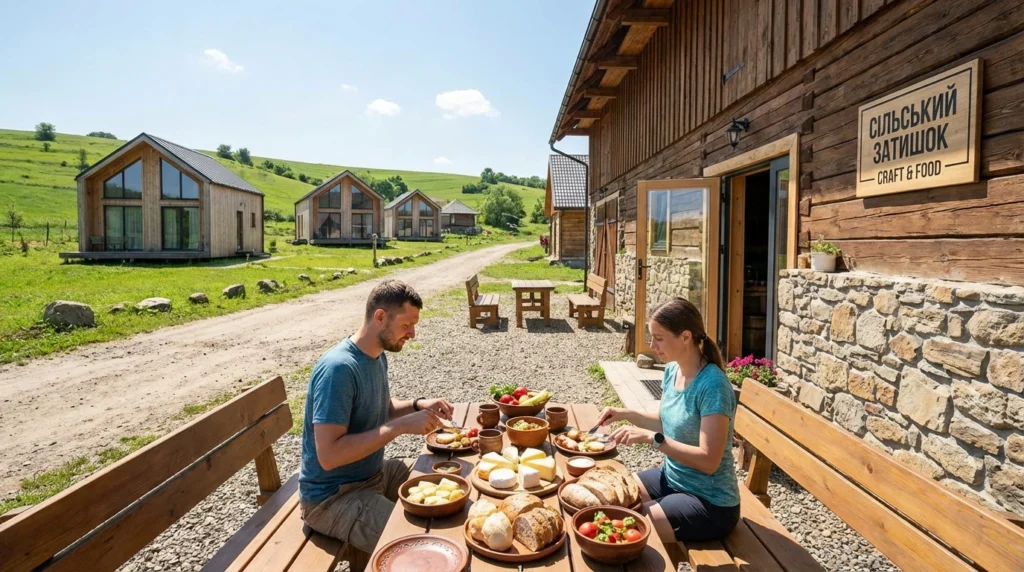
In the western highlands, the activities shift toward the natural world and the kitchen. A stay in Dzembronia often involves short hikes to the Smotrytska waterfalls, which cascade from heights of up to 100 meters. After a morning of trekking, the focus turns to Hutsul gastronomy. This is the land of banosh (creamy corn grits with bryndza cheese and mushrooms) and kulesha. Many homestays allow guests to watch, or even help, as meals are prepared over open fires or in traditional wood-burning stoves. The ingredients are almost exclusively local: milk from the neighbor’s cow, mushrooms foraged from the nearby forest, and herbs gathered from the mountain slopes.
For those staying closer to the capital, the open-air museum in Pirogovo offers a condensed version of this village life. While technically a museum, its vast territory functions like a living village, especially during autumn festivals. Here, you can witness the architectural diversity of Ukraine’s various regions, from the thatched roofs of the south to the wooden churches of the north, all while sampling traditional borsch served in the crisp autumn air.
Etiquette and Cultural Nuances in Ukrainian Homestays
Staying in a village homestay (locally known as a sadyba) is the best way to experience Ukrainian hospitality, but it comes with its own set of social norms. Understanding these nuances will ensure a warm welcome and a deeper connection with your hosts. First and foremost is the tradition of removing shoes. Upon entering a Ukrainian home, you should always leave your outdoor shoes at the door. Most hosts will provide ‘kapuptsi’ (slippers), but bringing your own lightweight indoor shoes is a thoughtful touch.
Gift-giving is another vital component of local etiquette. If you are staying with a family, bringing a small token of appreciation is highly valued. You don’t need anything expensive; high-quality coffee, a box of chocolates from a city bakery, or a small souvenir from your home country is perfect. Avoid giving an even number of flowers, as this is reserved for funerals in Ukraine.
Communication in rural areas may require a bit of creativity. While younger Ukrainians in cities are often fluent in English, village elders may only speak Ukrainian or a local dialect. Carrying a translation app that works offline is helpful, but don’t underestimate the power of gestures and a few basic Ukrainian phrases. A sincere ‘Dyakuyu’ (Thank you) or ‘Dobryi den’ (Good day) goes a long way. Additionally, always ask for permission before taking photos of locals, especially the elderly or people working in their private gardens. Most are happy to pose, but the gesture of asking shows respect for their privacy and lifestyle.
Practical Planning: Booking, Packing, and Safety
Planning a trip to rural Ukraine in 2026 requires a bit more foresight than a standard European city break. While digital platforms have expanded, many of the best sadybas in places like Dzembronia or the Poltava countryside are booked through local tourism portals or even via direct phone calls. When booking, clarify what is included—often, breakfast and dinner are part of the price, offering a much better value and more authentic food than seeking out a restaurant.
Packing for the village requires a focus on utility. Even in summer, mountain evenings in the Carpathians can be chilly, so layering is essential. Sturdy, waterproof footwear is a must, as village paths can be muddy or uneven. If you plan on visiting local churches, which are often the pride of the village, remember that modest dress is expected; women may want to carry a light scarf to cover their heads, and men should avoid wearing shorts inside religious buildings.
Safety and documentation remain a priority for any international visitor. Before you depart, ensure your travel documents are in order and that you have met all current entry requirements. For 2026, having specialized coverage is mandatory for all foreign arrivals. Securing your policy through ensures that you are covered for a wide range of scenarios, including those specific to the current regional climate. This coverage is not just a formality; it provides the logistical support necessary to explore remote areas with confidence.
Finally, consider the timing of your visit. Late spring (May and June) sees the countryside in full bloom, while autumn (September and October) offers the golden landscapes of Pirogovo and the harvest bounty of the Poltava region. Winter in the mountains is magical but requires more specialized gear and a tolerance for snow-blocked roads. Whichever season you choose, the Ukrainian village offers a rare opportunity to disconnect from the digital world and reconnect with a culture that remains fiercely proud of its roots and incredibly welcoming to those who take the time to visit.