 Ukraine Entry Guide for Nepal Citizens 2026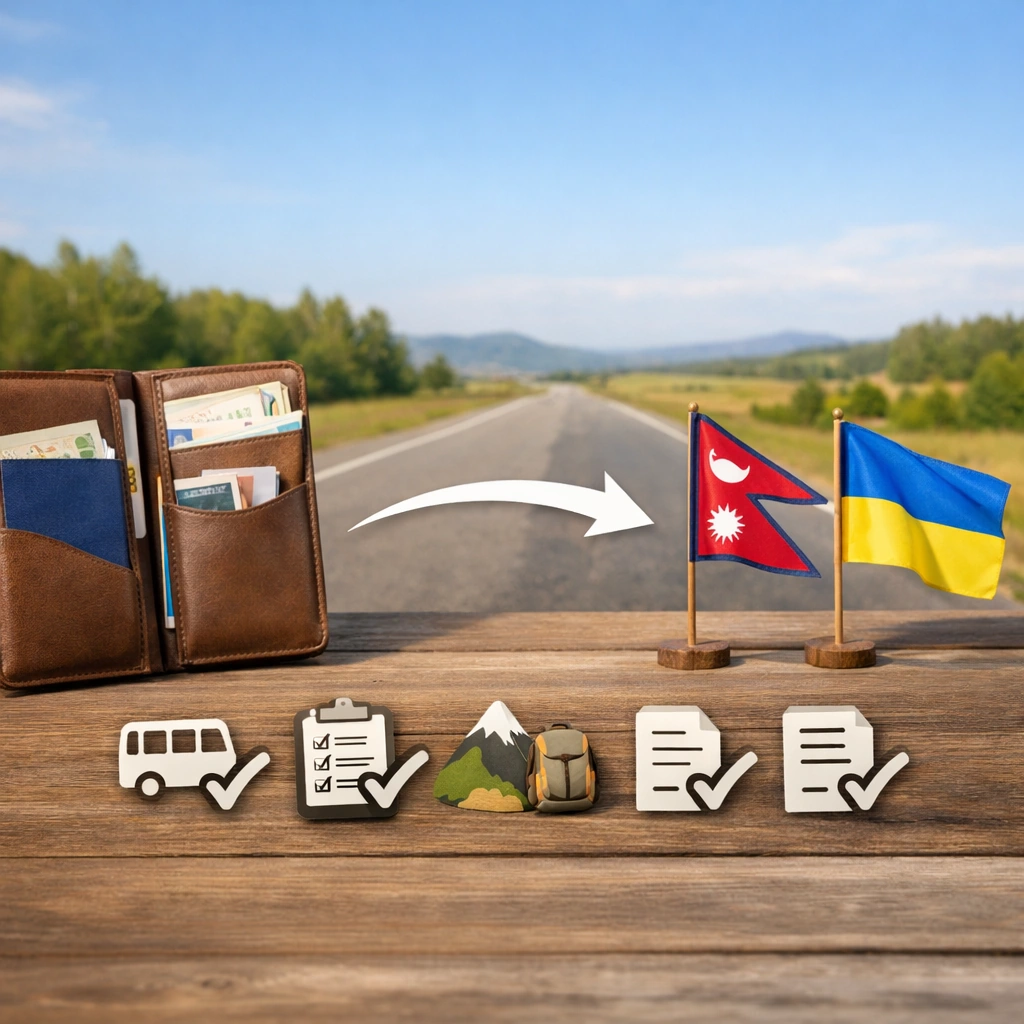
Key facts
Entry Rules for Nepal Citizens (2026)
Nepal citizens need a Ukrainian e-Visa for short stays in 2026. The e-Visa is issued for tourism, business, or private visits and allows single or double entry for up to 30 days. Apply online before travel and carry a printed copy of the approved e-Visa to present at border control.
Timing: submit your application no earlier than 3 months and no later than 10 business days before your planned arrival. Typical processing is 1–3 business days (standard vs expedited depends on the option you choose during application).
Fees: single-entry e-Visa USD 20; double-entry e-Visa USD 30 (paid online by bank card).
Financial means: border officers can ask you to prove you have enough funds for the trip and return. The minimum is calculated by Ukrainian rules using: FO = ((20 × Pm) ÷ 30) × (Kd + 5), where Pm is the 2026 subsistence minimum (3,209 UAH) and Kd is the number of days in Ukraine. Example: for 10 days, the minimum is about 8,086 UAH. Proof can be cash, bank cards with a statement, a paid hotel booking/tour voucher, or a host’s guarantee letter.
Required Documents
Prepare these documents for both the e-Visa application and the border check:
- Passport valid for at least 3 months beyond the planned departure date (many applicants use a longer buffer; if possible, keep 6+ months validity to reduce risk of travel disruption).
- Printed e-Visa (PDF printout) and a digital copy on your phone.
- Travel medical insurance valid for the entire stay (minimum coverage commonly accepted: EUR 30,000).
- Proof of trip purpose: hotel reservation, tour voucher, return/onward tickets, or an invitation letter (private or business).
- Proof of funds for the stay and return (cash, bank statement, card limits, sponsor/host guarantee).
- No entry ban: if you previously overstayed or violated rules in Ukraine, entry can be refused.
If your e-Visa is refused: you will receive a notice with the reason. Frequent causes are form mistakes, missing/incorrect documents, or weak financial proof. Reapply only after correcting the issue and ensuring your documents match your passport data exactly.
Travel Insurance
Ukraine requires foreign visitors to have medical insurance covering the full period of stay. Choose a policy that:
- Meets at least EUR 30,000 medical coverage.
- Covers inpatient/outpatient care, emergency treatment, and medical evacuation if needed.
- Matches your travel dates exactly (entry to exit).
Due to ongoing security risks in parts of the country, many travelers also choose insurance that includes war-related risks where available. You can compare suitable options on insurance-ukraine.com.
Safety
Ukraine operates under martial law in 2026. Conditions vary significantly by region. Plan your route carefully and follow local instructions.
- Emergency number: call 112 for all emergency services (operators can connect you to police, ambulance, fire, and gas emergency services).
- Carry ID: keep your passport (or a secure copy plus original when required) and visa printout accessible for checks.
- Checkpoints: you may be stopped for document and vehicle inspections. Stay calm, follow instructions, and avoid filming military personnel, equipment, or checkpoints.
- Air-raid alerts: follow local alert systems and move to shelter when instructed by local authorities or venue staff.
Customs
Green corridor (no written declaration) is for items that do not require taxation/permits. Typical allowances include:
- Personal belongings.
- Goods up to EUR 500 total value and up to 50 kg.
- Food products for personal use (not for sale) up to EUR 200.
- Cash up to EUR 10,000 (or equivalent). If you carry more, be ready to show bank documents proving withdrawal from your account and complete declaration.
- Medicines (non-narcotic/non-psychotropic): generally up to 5 packages of each medicine per person.
Red corridor (written declaration) is required for goods needing permits, higher-value items, certain medicines, cultural valuables, securities/payment documents, and amounts above the duty-free thresholds. Keep receipts; customs may assess value if documents are missing.
Prohibited or restricted imports include narcotics/psychotropic substances, explosives/poisons, certain uncertified food products, materials promoting violence/racism/war or pornography, unidentified animals, wanted cultural property, and weapons (including gas sprays/firearms/cold weapons) without the required Ukrainian permits.
Export rules: goods under EUR 10,000 can usually be exported without written declaration; higher values require declaration. Some categories (cultural/historical items, weapons/ammunition, narcotics, radioactive/explosive substances, and items violating intellectual property) are prohibited or require special permission. Food and medicine export restrictions can apply; if you plan to carry large quantities or prescription medicines, bring supporting documents.
Driving
Ukraine has right-hand traffic. Drivers must carry a valid driving licence and vehicle registration documents, and front-seat occupants must wear seat belts. Child transport rules apply: children under 12 must use appropriate child restraints; children cannot ride in the front seat without a child seat.
Speed limits (typical):
- Residential/pedestrian zones: 20 km/h
- Within settlements (cities): 50 km/h
- Outside settlements: 90 km/h
- Divided highways outside cities: 110 km/h
- Motorways: 130 km/h
Foreign-plate vehicles: foreign citizens can generally use a car with foreign plates in Ukraine for up to 1 year for personal use. If you stay longer than 2 months, temporary registration may be required through the relevant service center. After the one-year period, the vehicle must leave Ukraine.
Driving during martial law: expect checkpoints, roadblocks, and sudden route changes. Do not film checkpoints or military vehicles. At checkpoints, slow down, follow the “STOP” sign, keep hands visible, present documents on request, and open the trunk/interior for inspection if asked. Turn off dashcams if instructed by personnel.
Frequently asked questions
Do Nepal citizens need a visa for Ukraine in 2026?
Yes. Nepal citizens must obtain a Ukrainian e-Visa before travel. It is issued for tourism, business, or private visits for up to 30 days with single or double entry.
Can I get a Ukraine e-Visa on arrival?
No. The e-Visa must be approved online before you travel. Print the PDF and carry it to show at border control.
How long does the Ukraine e-Visa take to process and how much does it cost?
Processing typically takes 1–3 business days. The consular fee is USD 20 for a single-entry e-Visa and USD 30 for a double-entry e-Visa.
What insurance do Nepal travelers need for Ukraine?
You need travel medical insurance valid for your entire stay. A minimum medical coverage of EUR 30,000 is commonly required, and many travelers choose policies that also cover war-related risks.
How much money must I show at the Ukrainian border?
Ukraine can require proof of sufficient funds calculated by a legal formula using the 2026 subsistence minimum (3,209 UAH) and your trip length. Proof can be cash, bank statements, paid accommodation, or a host guarantee letter.
What is the duty-free limit when entering Ukraine?
Common duty-free allowances include goods up to EUR 500 and 50 kg, food for personal use up to EUR 200, and cash up to EUR 10,000 (or equivalent). Items above limits or requiring permits must be declared via the red corridor.