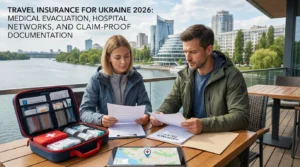

Entering Ukraine in 2026 involves a sophisticated understanding of risk management that goes beyond typical holiday planning. While the tourism sectors in cities like Lviv, Kyiv, and the Carpathian highlands are thriving, the legal and safety landscape remains unique. For any foreign national, securing the correct insurance is not just a matter of personal safety—it is a mandatory legal requirement for crossing the border. However, the most common mistake travelers make is assuming a standard international policy will suffice. In reality, many general policies contain hidden clauses that render them void the moment a traveler enters a country with active security alerts.
Minimum Coverage Expectations and Border Requirements
In 2026, Ukrainian border guards and international airlines maintaining routes to neighboring hubs (like Rzeszów or Chișinău) have strict protocols regarding insurance verification. A policy must meet several baseline criteria to be accepted at the point of entry. The standard minimum medical coverage remains at €30,000, but the composition of that coverage is what matters most to authorities.
A valid policy for 2026 must explicitly state that it covers medical expenses and repatriation. During border checks, officials often look for specific mentions of coverage that remains active during a state of emergency. If your policy document contains a blanket exclusion for “countries under travel advisories” or “regions with ongoing conflict,” you may be denied entry at the land checkpoints. It is highly recommended to carry a printed English or Ukrainian translation of your policy summary, highlighting the lack of a general war exclusion. Many travelers find that specialized providers, such as , offer the most reliable documentation because their certificates are designed to satisfy the specific scrutiny of the State Border Guard Service of Ukraine.
Airlines are equally vigilant. If you are flying into a neighboring country with the intent to transit into Ukraine by rail or bus, some carriers may ask to see your insurance before boarding. They do this to avoid liability should you be turned back at the border. Ensure your policy is valid for the entire duration of your stay, plus a buffer of at least 48 hours to account for potential transport delays at the busy border crossings of Medyka or Yahodyn.
Reading the Fine Print: War Exclusions and Curfew Incidents
The most significant pitfall in 2026 remains the “War Exclusion” clause. Most standard global insurance products automatically terminate coverage if an injury is caused by military activity, even if the traveler is a civilian in a relatively stable area. To travel safely, you must look for policies that include “Passive War Risk” coverage. This specific type of insurance covers accidents or injuries resulting from fragments, air alerts, or other indirect consequences of the security situation, provided the traveler was not actively participating in hostilities.
Another critical area of concern is the adherence to local laws, specifically curfews. In 2026, several Ukrainian regions maintain night-time curfews to ensure public order. If an incident occurs—such as a trip and fall or a medical emergency—while you are outside during curfew hours without a valid permit, your insurance provider will almost certainly deny the claim. The policy is legally tied to your compliance with local administrative regulations. Similarly, risky activities like visiting restricted zones near the northern or eastern borders without official accreditation will void your coverage instantly.
When reviewing a policy, look for the definition of “Terrorism” versus “War.” In some legal frameworks, these are treated differently. A policy might cover a terrorist act in a shopping mall but exclude a missile strike. In the Ukrainian context of 2026, you need a policy that bridges these definitions to ensure that regardless of the technical classification of an incident, your medical bills and emergency evacuation are paid for.
How Claims Work: Documentation and Hotline Scripts
The effectiveness of your insurance is only proven at the moment of a claim. In Ukraine, the process requires immediate action and precise documentation. If you require medical attention, the first step is always to contact the insurance company’s assistance hotline before paying for any services. Most specialized insurers for Ukraine provide 24/7 support via Telegram, WhatsApp, or local phone lines.
When calling the hotline, use a clear script: “I am in [City], Ukraine. My policy number is [Number]. I have a medical emergency and need a guarantee of payment sent to [Name of Hospital].” This ensures the hospital knows they will be paid directly by the insurer, saving you from significant out-of-pocket expenses. If you are in a remote area, such as a mountain trail in the Carpathians, you must clarify if the insurer covers private ambulance services, as state resources may be prioritized for other needs.
The documentation required for a successful claim in 2026 includes:
- A medical report with a stamp and signature from the attending physician.
- An itemized invoice of all treatments and medications purchased.
- In the event of a security-related incident, a police report or a certificate from the State Emergency Service.
- Proof of your legal presence in the country (passport stamp).
Using a dedicated platform like can simplify this, as they often have direct billing agreements with major private clinics in Kyiv, Lviv, and Odesa, reducing the bureaucratic burden on the traveler.
Add-ons Worth the Investment: Evacuation and Electronics
Standard medical coverage is the bare minimum, but 2026 travel demands more comprehensive protection. One of the most valuable add-ons is Emergency Evacuation and Repatriation. This covers the high cost of specialized transport (such as a private medical vehicle) from Ukraine to a neighboring EU country like Poland or Romania. Given that air travel within Ukraine remains restricted, land-based medical evacuation is the only viable route, and it can cost thousands of euros without insurance.
Trip interruption insurance is another essential consideration. In 2026, logistics can be unpredictable. A sudden change in the security status of a region might lead to the cancellation of train services or the closure of certain roads. A policy that covers “Cancel for Any Reason” or specifically mentions “Interruption due to Security Escalation” allows you to recover the costs of non-refundable hotel bookings and missed international connections.
Finally, consider electronics coverage. Ukraine has become a hub for digital nomads, journalists, and volunteers who travel with expensive laptops, cameras, and drones. Standard travel insurance often caps electronics payouts at a few hundred euros. Given the reliance on technology for navigation and communication in 2026, insuring your gear against theft or accidental damage—especially during long-haul train journeys—provides significant peace of mind. Ensure the policy covers these items while they are in transit, not just while they are locked in a hotel safe.