Exploring Ukraine by car in 2026 offers a level of freedom that public transport simply cannot match. As the country continues its extensive infrastructure reconstruction, the road network has seen significant improvements, connecting major hubs like Kyiv, Lviv, and Odesa with modern highways. However, driving here requires more than just a GPS and a sense of adventure. The 2026 landscape involves a specific set of security protocols, updated insurance laws, and urban challenges that every international visitor must understand before getting behind the wheel.
Essential Documentation for Foreign Drivers
Before entering Ukraine or renting a vehicle, you must ensure your paperwork is in perfect order. Ukrainian patrol police are professional but strict regarding documentation. You are required to carry your original passport, a valid driver’s license, and the vehicle’s registration document (often called a technical passport).
If your driver’s license was issued in a country that is not a signatory to the Vienna Convention on Road Traffic, or if the license does not contain a Latin script translation, you must carry an International Driving Permit (IDP). Even for those with EU or US licenses, having an IDP is highly recommended to avoid any linguistic misunderstandings during routine checks.
Insurance is the most critical legal requirement. As of January 1, 2026, Ukraine has implemented significant updates to the Motor Transport Professional Liability (MTPL) system. Foreign-registered vehicles must have a valid Green Card, while those renting locally or staying long-term must ensure they have a modern MTPL policy. You can obtain the necessary 2026-compliant coverage at to ensure you are protected under the new direct settlement laws. These laws now allow victims of accidents to receive compensation directly from their own insurance provider, streamlining a process that was previously much more complex for foreigners.
Navigating Checkpoints and Security Etiquette
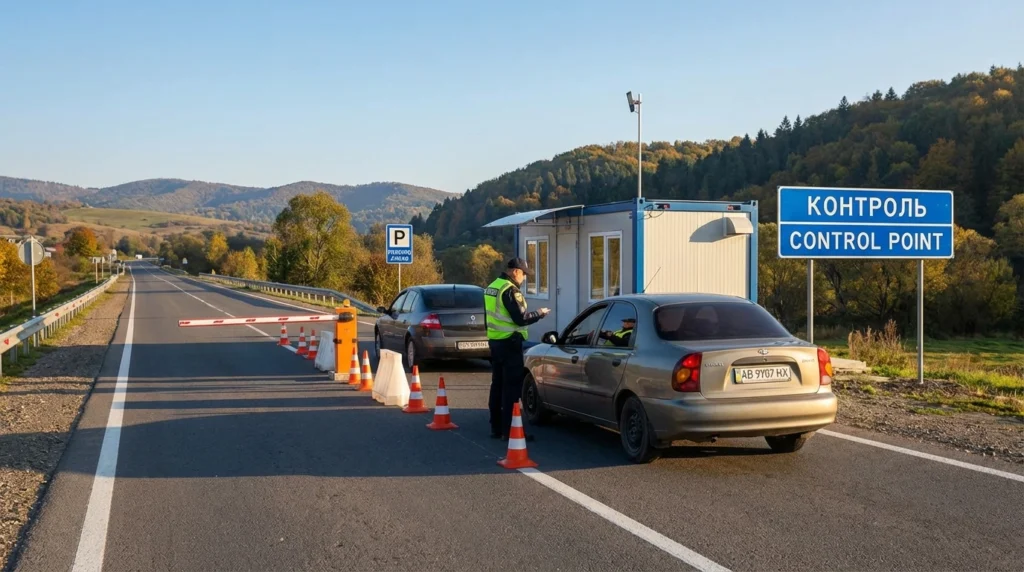
While the number of internal checkpoints has decreased significantly by 2026, they remain a standard feature near borders, strategic bridges, and entrances to major cities. Understanding the etiquette at these stops is vital for a smooth journey. Approach a checkpoint at a reduced speed, following the posted signs (usually ‘STOP’ or ‘REDUCE SPEED’).
At night, always switch off your high beams and turn on your interior cabin light so the officers can see inside the vehicle. Keep your hands visible on the steering wheel as the officer approaches. Lower your window fully. You will likely be asked for your documents and perhaps the purpose of your travel. Common questions include “Where are you coming from?” and “Where are you headed?” Answer clearly and calmly.
One of the most important rules for 2026 is the strict prohibition of dashcams. While popular in other European countries, dashcams are currently restricted in Ukraine to prevent the accidental recording of military movements or sensitive infrastructure. Ensure your dashcam is unplugged and stored away. Additionally, never take photos or videos of checkpoints, personnel, or damaged military hardware along the roads. Doing so can lead to the confiscation of your device and lengthy questioning.
Urban Realities: Parking and Driving in Kyiv, Lviv, and Odesa
City driving in Ukraine is a fast-paced experience. In Kyiv, the primary challenge is congestion. The city’s bridges across the Dnipro River can become bottlenecks during morning and evening rush hours. Lviv, by contrast, presents a challenge with its narrow, cobblestone streets and extensive tram network. Always give way to trams; they have the right of way in almost every scenario.
Parking in 2026 has become almost entirely digital in major cities. In Kyiv and Lviv, you will rarely find physical parking meters. Instead, use official municipal apps like ‘Kyiv Digital.’ These apps allow you to enter your license plate and pay via credit card or Apple/Google Pay. Be wary of ‘self-appointed’ parking attendants—individuals who offer to find you a spot for a cash tip. These are not official, and paying them does not protect you from a municipal fine or having your car towed. If you park illegally, especially in a way that blocks tram lines or emergency exits, your vehicle will be towed within minutes.
Odesa driving culture is notably more aggressive than in the west of the country. Drivers often change lanes quickly without signaling. Maintain a safe following distance and stay alert. In all cities, be mindful of the ‘green arrow’ signal. At many intersections, a small green arrow sign next to the red light allows you to turn right even when the light is red, provided you yield to all pedestrians and cross-traffic.
Accident Protocol and the 2026 Insurance Reforms
If you are involved in a road traffic accident (RTA), the procedure depends on the severity of the incident. Under the 2026 regulations, minor accidents with no injuries and where both drivers agree on the circumstances can be settled using a ‘Europrotocol.’ This is an electronic or paper form that allows you to document the accident without calling the police. This is only possible if both parties have valid insurance and are not under the influence of alcohol or drugs.
However, if there are any injuries, or if the damage to the vehicles is significant, you must call the police (102) and, if necessary, medical services (103). Do not move the vehicles until the police have arrived and documented the scene, as this can void your insurance claim. Under the new laws active in 2026, if you are the victim of an accident caused by an uninsured driver, your own insurance company is now obligated to handle your compensation through the direct settlement mechanism. This provides a much-needed safety net for international travelers who may be unfamiliar with local legal proceedings. Always keep a digital copy of your policy from accessible on your phone to present to the authorities if required.
What Tourists Should Never Do
To ensure a safe trip, there are several hard boundaries you must never cross. First, never drink and drive. Ukraine has a near-zero tolerance policy (0.2 ppm), which is effectively one small beer for some or nothing at all for most. The penalties in 2026 are severe, including heavy fines and immediate revocation of driving privileges.
Second, never ignore air quality or safety sirens if they occur in the region you are traversing. While 2026 is a period of stabilization, safety protocols remain in place. If sirens sound, pull over safely and seek the nearest shelter. Most modern navigation apps in Ukraine now integrate real-time safety alerts to guide you to the closest secure location.
Finally, never attempt to offer ‘informal payments’ to traffic police. Ukraine has made massive strides in anti-corruption efforts, and the patrol police are equipped with body cameras. Attempting to bribe an officer is a serious criminal offense that will result in arrest and prosecution. Treat officers with respect, provide your documents when asked, and follow the legal process for any citations issued.