 Ukraine Entry Guide for Timor Leste Citizens 2026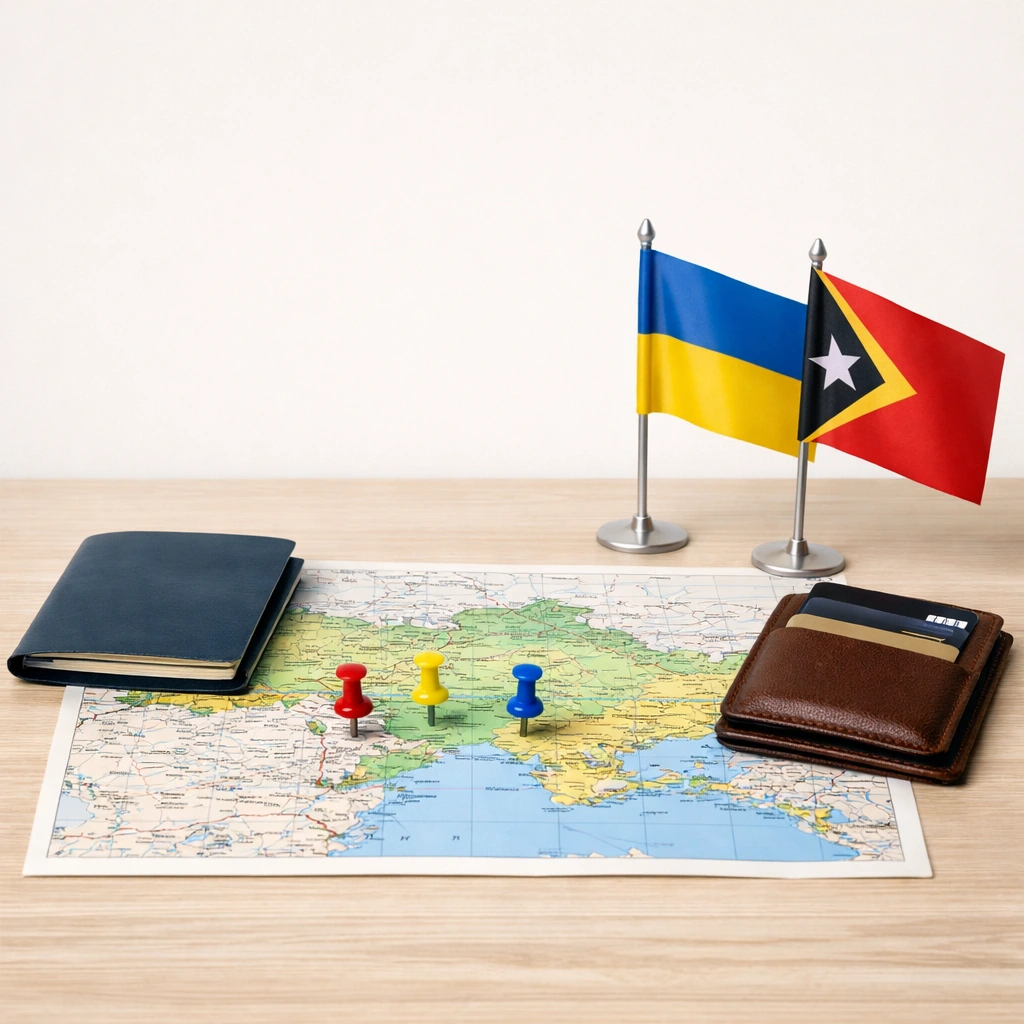
Key facts
Entry Rules for Timor-Leste Citizens (2026)
Timor-Leste citizens need a Ukrainian electronic visa (e-Visa) for short trips in 2026. The e-Visa is issued for tourism, business, or private visits and allows single or double entry for a stay of up to 30 days.
Processing time: typically 1–3 business days (standard/expedited options may be available). Apply early to avoid delays.
Application window: submit your e-Visa application no earlier than 3 months before travel and no later than 10 business days before your planned entry date.
COVID-19: Ukraine has no COVID-related entry restrictions in 2026.
Required Documents
At the border, be ready to show:
- Passport (recommended validity: at least 6 months beyond your planned entry date; minimum practical requirement is often stated as 3 months, but longer validity reduces border and visa risks).
- Printed e-Visa (carry a paper copy and keep the PDF on your phone).
- Travel medical insurance covering the entire stay (minimum coverage commonly required for e-Visa: €30,000).
- Proof of trip purpose: hotel booking, invitation letter, return/onward tickets, itinerary.
- Proof of sufficient funds for the stay and return.
- No active entry ban to Ukraine.
How much money do you need for entry? Ukraine uses a formula based on the 2026 subsistence minimum (3,209 UAH): FO = ((20 × Pm) ÷ 30) × (Kd + 5), where Kd is the number of days in Ukraine. Example: for a 10-day stay, the minimum is about 8,086 UAH.
Accepted proof of funds: cash, bank cards with a recent statement, prepaid accommodation/tour voucher, or a host’s guarantee letter.
Travel Insurance
A medical insurance policy is mandatory for Timor-Leste citizens entering Ukraine. For e-Visa applications, prepare insurance with at least €30,000 coverage and validity for the full trip (including entry/exit days).
Ukraine remains under martial law in 2026, so choose a policy that clearly covers emergency care, hospitalization, and accident injuries, and check whether it includes war-related risks if you plan to travel near higher-risk areas. Many travelers arrange suitable coverage via insurance-ukraine.com.
Safety
Ukraine has enhanced security measures due to martial law. Plan your route carefully and follow local instructions.
- Emergency number: call 112 for all emergency services (police, ambulance, fire).
- Carry identification (passport + e-Visa printout) and keep digital copies stored securely.
- Checkpoints: expect document checks between regions and in some cities. Follow instructions calmly and avoid filming or photographing military sites, vehicles, or checkpoints.
- Air-raid alerts: learn the shelter location at your hotel/apartment and follow local announcements.
Customs
Ukraine uses a green and red customs corridor system.
Green corridor (no written declaration, if within limits):
- Personal belongings.
- Goods up to €500 total value and up to 50 kg.
- Food for personal use (not for sale) up to €200.
- Cash up to €10,000 (or equivalent). If you carry more, you must declare it and may need bank documents proving withdrawal.
- Medicines (non-narcotic/non-psychotropic): generally up to 5 packages of each medicine per person.
Red corridor (written declaration required): goods requiring permits, currency/cultural values, securities/payment documents, controlled medicines, and items exceeding the €500/50 kg limits.
Prohibited to import: narcotics/psychotropic substances, explosives/poisons, uncertified food products, materials promoting violence/racism/war or pornography, unidentified animals, wanted cultural property, and weapons (including gas/spray weapons) without the required permits.
Export rules (key points): goods under €10,000 may be exported without written declaration in many cases. Items restricted by law, cultural valuables, and higher-value exports may require declaration and permits. Certain foods and medicines can be restricted for export; if you are carrying prescription medicines, keep the prescription and original packaging.
Driving
Ukraine has right-hand traffic. Keep your driver’s license, vehicle registration, and insurance documents with you while driving.
Speed limits (typical):
- Residential/pedestrian zones: 20 km/h
- Within cities: 50 km/h
- Outside cities: 90 km/h
- Roads with a dividing strip: 110 km/h
- Highways: 130 km/h
Seat belts: driver and front passenger must wear seat belts.
Children in cars: children under 12 must use appropriate child restraints; children must not ride in the front seat without a child seat; children over 12 must wear seat belts.
Driving during martial law: expect checkpoints and occasional road obstacles. Slow down early, prepare documents, and follow instructions. Do not film checkpoints or military equipment. At checkpoints, stop at the sign, use hazard lights if instructed, keep hands visible, and open the trunk/interior for inspection if requested.
Frequently asked questions
Do Timor-Leste citizens need a visa for Ukraine in 2026?
Yes. Timor-Leste passport holders must obtain a Ukrainian e-Visa before travel. It is issued for tourism, business, or private visits for up to 30 days (single or double entry).
Can I get an e-Visa after arriving in Ukraine?
No. The e-Visa must be approved online before you travel to Ukraine.
What insurance coverage is required for the Ukraine e-Visa?
Prepare travel medical insurance valid for the entire stay with coverage of at least €30,000. Check the policy wording carefully and consider coverage for war-related risks depending on your itinerary.
How much money do I need to show at the border?
The minimum is calculated using FO = ((20 × 3,209 UAH) ÷ 30) × (days of stay + 5). For a 10-day trip, it is about 8,086 UAH. Proof can be cash, bank cards with a statement, prepaid accommodation, or a host guarantee letter.
Can I work in Ukraine with an e-Visa?
No. The e-Visa is for short-term visits (tourism, business meetings, private visits) and does not allow employment.
What is the emergency phone number in Ukraine?
Dial 112 for all emergency services (police, ambulance, fire and other urgent assistance).