Entering Ukraine by land in 2026 is straightforward on the western borders, but it rewards careful planning. Queue times can swing from minutes to many hours, public transport schedules don’t always align with border processing, and curfew rules inside Ukraine can affect late-night arrivals. This guide compares the most-used crossings via Poland, Slovakia, Hungary, and Moldova, then walks you through checkpoint-by-checkpoint tactics, missed-connection fixes, and backup plans.
Quick reality check for 2026: Ukraine’s western borders are open to Ukrainian citizens and foreign nationals who meet entry requirements. Travel risks remain higher in some regions, while much of western and central Ukraine (including Lviv, Ternopil, Ivano-Frankivsk, and Kyiv) continues to receive visitors. Air-raid alerts can occur anywhere, so keep notifications enabled on a reliable alert app and plan accommodation with shelter access.
How to pick a route: time, transfers, night travel, and curfew considerations
The “best” checkpoint depends less on distance and more on how you’re traveling (bus, train, car, on foot) and what you need on the Ukrainian side (Lviv, Uzhhorod, Kyiv connections, etc.). Use these four filters before you buy tickets.
1) Total travel time = border time + onward connections
- Poland routes often have the most transport options (buses, shuttles, rideshares) but can be the busiest.
- Slovakia route is usually the simplest for reaching Uzhhorod and the Zakarpattia region with fewer transfers.
- Hungary routes are efficient for reaching Chop and onward rail links, but service frequency can be lower than Poland.
- Moldova routes are practical if you’re flying into Chișinău and heading toward Odesa region or southern Ukraine (depending on your destination and current advisories).
2) Transfers: minimize “tight connections” after the border
Border processing is unpredictable. Avoid schedules that require you to catch a specific train/bus within 30–60 minutes after crossing. Build a buffer of 2–4 hours if you must connect the same day, and consider booking flexible tickets where possible.
3) Night travel: choose crossings that match your arrival window
Some travelers prefer crossing early morning (shorter queues, more same-day connections). Others arrive late to save a hotel night—this can backfire if you cross after dark and then face limited transport options. If you plan to arrive late, pre-arrange a pickup or plan an overnight stop near the border on the Ukrainian side.
4) Curfew inside Ukraine: plan your first night realistically
Curfew rules can vary by region and can change. Even if the border is open, arriving in a city during curfew may mean limited movement, fewer taxis, and closed services. Practical approach:
- Target arrival to your first Ukrainian city before evening.
- If arriving late, book accommodation within easy reach of the station/bus terminal and confirm late check-in.
- Keep your first night simple: one transfer maximum after crossing.
Checkpoint-by-checkpoint planning tips (documents, queues, peak days)
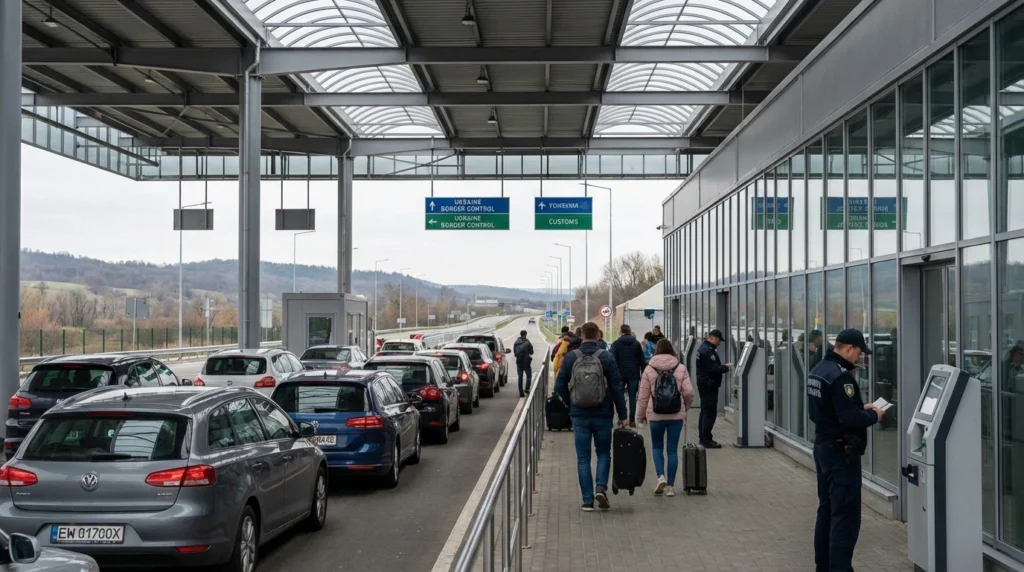
Below are the most frequently used land crossings in 2026 and what they’re best for. Conditions can change quickly, so treat this as a planning framework rather than a promise of speed.
Documents checklist (foreign nationals)
- Passport valid for the duration of stay (and ideally with extra validity beyond your trip).
- Visa if your nationality is not visa-free for Ukraine or if your purpose/length of stay requires it.
- Proof of purpose (hotel bookings, invitation letter, itinerary, volunteer documentation, business meeting details—bring what fits your case).
- Proof of funds (card + recent statement or cash; requirements are applied case-by-case).
- Health insurance valid for Ukraine; border officers may request it. Many travelers arrange a policy in advance via services such as .
Peak days and queue patterns (practical expectations)
- Fridays and Sundays often see heavier traffic due to weekend movement.
- Holiday periods in neighboring EU countries can increase queues.
- Early morning can be smoother for some crossings, but not always—bus convoys can create spikes.
- Pedestrian lanes (where available) may be faster than cars during vehicle congestion.
Poland → Ukraine
Best for: widest choice of buses and onward routes to Lviv and central Ukraine.
- Medyka–Shehyni (pedestrian + vehicles): One of the most popular options. If you’re on foot, confirm where your onward transport departs on the Ukrainian side and how late it runs. If you’re in a car, expect variable waits—arrive with water, snacks, and a full phone battery.
- Korczowa–Krakovets (vehicles): Often chosen by drivers and long-distance buses. Good for reaching Lviv region by road. If you’re on a bus, keep documents accessible—operators may collect passports for processing depending on the service.
- Hrebenne–Rava-Ruska (vehicles): A strong alternative when other Poland crossings are overloaded. Useful for reaching northern Lviv region and connecting onward by road.
Poland route tip: If you’re flying into Poland, airports commonly used for border-bound travel include Rzeszów and Lublin. From there, buses and shuttles run toward border towns—just avoid last departures if you haven’t built in border time.
Slovakia → Ukraine
Best for: reaching Uzhhorod and Zakarpattia with fewer transfers; a calmer alternative to the busiest Poland points.
- Vyšné Nemecké–Uzhhorod: The main crossing on this route. It’s a practical choice if your destination is Uzhhorod, Mukachevo, or you’re continuing toward Lviv by train/bus from Zakarpattia. Have a plan for onward transport—frequency can be lower than on Poland routes.
Slovakia route tip: Košice is a convenient staging city. If you arrive late, consider sleeping in Košice and crossing early to reduce the risk of being stranded after the border.
Hungary → Ukraine
Best for: Chop rail connections and Zakarpattia access; useful if you’re coming via Budapest or Debrecen.
- Záhony–Chop: A classic gateway to Chop, where onward rail options can be strong depending on the timetable. Good for travelers who prefer train-based itineraries.
- Lónya–Dzvinkove: A smaller alternative that can help when the main crossing is congested, especially for drivers who can reroute.
Hungary route tip: If you’re relying on a specific train after Chop, do not schedule it too tightly. Border delays can easily erase a “safe-looking” 45-minute connection.
Moldova → Ukraine
Best for: travelers flying into Chișinău and heading toward southern Ukraine; also useful for certain overland itineraries from Romania via Moldova.
- Palanca–Maiaky–Udobne: A key corridor used by buses and cars. Confirm your bus operator’s route and border stop sequence—some services handle formalities more smoothly than others.
- Otaci–Mohyliv-Podilskyi: A practical alternative depending on your onward destination in Ukraine.
Moldova route tip: Keep an eye on your onward leg inside Ukraine—southern routes can involve longer distances between hubs, and late arrivals may limit transport choices.
What to do if you miss the last connection after crossing
Missing the last bus or train is one of the most common problems for first-time visitors entering Ukraine by land. The fix is usually simple if you act quickly and prioritize safety.
Step 1: Decide whether to stay put or move to the nearest hub
- If it’s late and transport is scarce, stay near the border town and travel onward in the morning.
- If you can still reach a larger city (Lviv, Uzhhorod, Chop area hubs) by taxi or a remaining shuttle, it may be worth moving—larger hubs have more hotels and morning departures.
Step 2: Secure a safe overnight option
- Book a hotel/guesthouse with late check-in and confirm by message or phone.
- Choose accommodation close to where you are (station, border-adjacent town center) to avoid long night rides.
- If you’re traveling on a tight budget, ask at the station/bus stop for the nearest open hotel rather than wandering.
Step 3: Use official taxis and keep proof of the ride
- Prefer app-dispatched taxis where available, or reputable local services recommended by your accommodation.
- Agree on the price before departure if it’s not metered/app-based.
- Share trip details with a friend: car plate, driver name, destination.
Step 4: If you need help with entry issues
If you’re delayed due to documentation questions (insurance, purpose of visit, length of stay, prior overstays), don’t improvise explanations. Present consistent documents and, if needed, seek professional guidance. SafeTrip Ukraine can connect travelers with migration lawyers in Ukraine for case-specific support.
Backup plans: alternative crossings and emergency contacts
A good border plan includes a “Plan B” you can execute in minutes—especially if you’re driving or using flexible bus tickets.
Alternative crossings: build a reroute map
- If Poland crossing is overloaded: consider switching between Medyka–Shehyni, Korczowa–Krakovets, and Hrebenne–Rava-Ruska depending on your approach route and transport mode.
- If you’re near Slovakia/Hungary: Vyšné Nemecké–Uzhhorod and Záhony–Chop can be smart fallbacks when Poland queues spike.
- If your itinerary starts in Romania/Moldova: keep Palanca–Maiaky–Udobne and Otaci–Mohyliv-Podilskyi as interchangeable options based on your onward destination.
Emergency contacts and essentials to save before you travel
- Your embassy/consulate contact details (phone + address in Ukraine and in the neighboring country you transit).
- Ukrainian emergency numbers: 112 (general emergency), 101 (fire), 102 (police), 103 (ambulance).
- Your insurer’s hotline and policy number (screenshots + printed copy). If you buy insurance online, save the PDF offline.
- Accommodation contacts for your first two nights in Ukraine.
- Offline maps for the border region and your first destination city.
Border-day packing list (small but important)
- Water and snacks (queues can be long).
- Power bank + charging cable.
- Warm layer/rain protection (especially for pedestrian crossings).
- Cash in small denominations (for local taxis, small purchases).
- A printed folder with passport copy, insurance, bookings, and return/onward plan.
With the right checkpoint choice and a realistic buffer for delays, crossing into Ukraine by land in 2026 can be smooth. The winning strategy is simple: arrive earlier than you think you need to, keep documents organized, and always have a same-day backup for transport and accommodation.