Plan your route before you start
You can cover a useful cross-section of Kyiv architecture in half a day, but you need to plan it as a one-way walk. The city is large, and some areas are easier to reach on foot than others. In 2026, you also need to check current local safety guidance before you go, since access rules and movement advice can change.
A practical route starts in the historic upper city, then continues down toward central Kyiv and Podil. That lets you compare medieval, baroque, imperial, Soviet and contemporary buildings without repeating the same streets. Wear comfortable shoes. You will walk on hills, steps and uneven pavement.
If you want the simplest version, begin near St Sophia Cathedral, continue to St Michael’s Golden-Domed Monastery, then walk to St Andrew’s Church and down toward the centre. From there, you can move along Khreshchatyk, stop at key Soviet-era buildings and finish near Podil for a look at newer glass towers.
Start with Kyiv’s oldest landmarks
St Sophia Cathedral is the best place to begin if you want the oldest surviving layer of Kyiv’s architectural history. The cathedral dates to the 11th century and is one of the city’s most important monuments. Its value is not only religious. It shows how early Kyiv connected with the wider medieval world.
From there, walk to St Michael’s Golden-Domed Monastery. The present buildings are modern reconstructions, but the site still matters because it links the city to its long religious and political history. The golden domes make it easy to spot from a distance, and the complex gives you a clear contrast with the more restrained Soviet buildings you will see later.
Next, continue to St Andrew’s Church, one of Kyiv’s best-known baroque buildings. Designed by Bartolomeo Rastrelli and completed in 1754, it stands on a steep hill and looks over the old city. The church is useful for your route because it shows a different scale and style from the cathedral buildings nearby. The exterior is the main reason to stop here, especially if you are comparing domes, façades and hilltop placement.
Move from imperial Kyiv to Soviet central streets
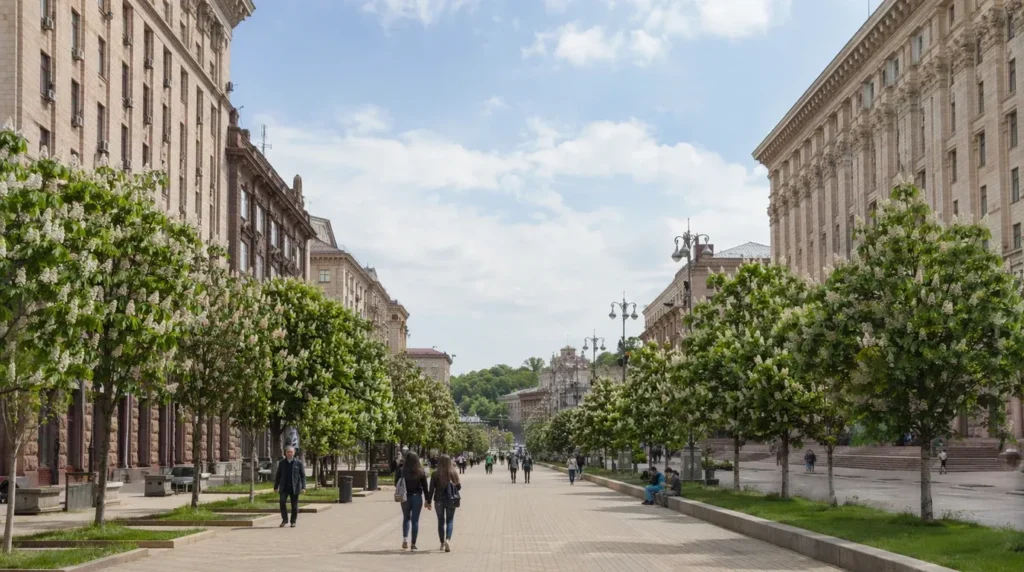
After the upper city, head toward the central boulevard area. Khreshchatyk is the key street for understanding how much of central Kyiv was rebuilt after the Second World War. The avenue was reconstructed in a Soviet neo-classical style, with broad façades, regular lines and a deliberately monumental feel. It is one of the clearest examples of post-war planning in the city.
Look carefully at the scale of the street. Khreshchatyk is not about decorative detail. It is about control, symmetry and urban theatre. That makes it very different from the older religious buildings. If you are taking photos, stand back. The street reads better in wide views than in close-up fragments.
Nearby, the Ministry buildings around European Square show a more severe Stalinist approach. These structures are heavier and more formal than the Khreshchatyk façades. They help you understand the political language of Soviet architecture in Kyiv. Even if you do not go inside, the exterior massing is enough to see the difference.
Use the metro stations as part of the route
Kyiv’s metro stations are not just transport stops. Some of them are architectural stops in their own right. Zoloti Vorota is one of the best-known examples. Its interior design draws on medieval motifs and gives you a more decorative Soviet-era public space than the buildings above ground.
Teatralna is also worth including if your route passes nearby. It is less ornate than Zoloti Vorota, but it still shows how the metro system was used to project civic identity. If you are short on time, choose one station rather than trying to see several. The point is to compare the atmosphere of the underground spaces with the streets above.
You need to check station access before you rely on the metro for your route. In 2026, operating conditions can change. Do not assume every station entrance or exit is open. Build some flexibility into your plan.
Finish in Podil for a modern contrast
To end the walk, head toward Podil. This district gives you a different Kyiv again. Here you can see newer glass towers and recent commercial development beside older low-rise streets. The contrast is useful because it shows how the city keeps layering new architecture on top of older urban fabric.
Podil is also a good place to slow down and review the route you have just walked. You have moved from medieval religious architecture to baroque church design, then to Soviet neo-classicism, Stalinist state buildings, modernist massing and contemporary development. Few European capitals let you compare so many periods in one day without leaving the centre.
If you want to add one more Soviet-era stop, look around the October Palace area. The surrounding forms are useful if you are interested in late-Soviet modernist influence and late Soviet urban design. You do not need to treat every building as a separate sight. Often the street composition is the main lesson.
How to walk it safely and sensibly
Keep the route simple. Start early. Allow time for detours, checkpoints, closed sections or changes in access. In Kyiv, you should always check local conditions on the day you go out. If you hear air-raid alerts, follow local instructions immediately and move to shelter.
Do not try to cover too much ground. A good architecture walk is about observation, not speed. Stop often. Look at façades, rooflines, materials and street width. Compare how each period uses space. That is the easiest way to understand Kyiv’s architectural story.
If you want food or a rest break, choose a café on the route rather than making a long side trip. The centre is walkable, but hills and distances add up. A half-day route works best when you keep it focused.
What to look for at each stop
You will get more from the walk if you know what to notice.
- At St Sophia Cathedral, look for the age of the structure and its historic role.
- At St Andrew’s Church, compare the baroque curves with the hilltop setting.
- On Khreshchatyk, notice the post-war symmetry and broad street plan.
- At the ministry buildings, look for Stalinist mass and formal repetition.
- At Zoloti Vorota and Teatralna, compare underground decoration with the streets above.
- In Podil, watch how new glass buildings sit beside older neighbourhood fabric.
That is enough to make the route useful without turning it into a museum checklist. You are reading the city through its buildings, one district at a time.
FAQ
How long does this architecture walk take?
Allow about four to six hours if you want to walk slowly and stop for photos. You can do a shorter version in two to three hours, but you will miss some of the comparisons between periods.
Do you need a guide for this route?
No. You can do it on your own if you are comfortable navigating central Kyiv. A guide can help if you want deeper historical context, but it is not necessary for the basic route.
Which stop is best for baroque architecture?
St Andrew’s Church is the clearest baroque stop on this route. If you want an older religious landmark as well, include St Sophia Cathedral and compare the different styles.
Can you use the metro between stops?
Yes, but do not depend on it for every transfer. The route is designed to work on foot, and metro access or station operations can change. Use it only if it helps on the day.
Is this walk suitable in winter?
Yes, but you need warm clothing and good shoes. Ice, wind and short daylight hours can make the hills and steps harder. In winter, keep the route shorter and allow extra time.
Can I photograph government and official buildings?
Be careful. Ukraine is under martial law in 2026, so you should not photograph government, military, police, checkpoint or critical-infrastructure buildings. Photographing ordinary churches, metro interiors and street architecture is generally fine. If police or security challenge you, stop at once, delete images on request, and move on. When in doubt, do not take the photo.