Entering Ukraine by car in 2026 is straightforward when your paperwork matches your situation: who owns the vehicle, who is driving, and what insurance is valid on Ukrainian roads. Most delays at the border (and most roadside stress later) come from the same few issues: missing proof of ownership, unclear permission to use someone else’s car, or insurance that looks “international” but doesn’t actually cover Ukraine.
This guide focuses on practicalities for foreign-plated cars: the documents you should have in hand, how to buy the right insurance without overpaying or getting the wrong product, what border officials and police typically ask for, and the first steps after a crash.
Required documents for foreign cars: what to prepare before you queue
Bring originals where possible, plus clear copies (paper or phone scans). Border staff may accept copies for some checks, but originals prevent arguments.
1) Passport and entry basis
- Passport valid for the duration of your stay.
- Visa or visa-free eligibility if applicable. Many nationalities can enter visa-free for up to 90 days within a 180-day period.
2) Driver’s license + IDP (International Driving Permit)
- National driver’s license (plastic card) is required.
- IDP: strongly recommended if your license is not in Latin script or if you want to avoid translation disputes. Some rental/insurance situations also expect it.
3) Vehicle registration certificate
- Original registration (V5C, Zulassungsbescheinigung, etc.).
- Make sure the plate number and VIN are readable and match the car.
4) Proof of ownership and the “right to use” the car
This is where many foreign drivers get stuck. Ukraine needs to see that you’re not importing a car informally and that you’re allowed to drive it.
- If you own the car: registration in your name is usually enough. If ownership is separate from registration in your country, carry a purchase contract or other ownership proof.
- If the car belongs to someone else (family member, friend, company): bring a power of attorney / authorization letter allowing you to drive the vehicle abroad and enter Ukraine. Ideally it should include the VIN, plate number, your full name, and dates/territory.
- Company car: carry a letter from the company authorizing use, plus a contact person and phone number. If the driver is not the registered keeper, expect questions.
Practical tip: If your authorization document is not in Ukrainian or English, bring a certified translation. It’s not always demanded, but it can save hours if an officer is unsure.
5) If you’re towing or carrying extra equipment
- Trailer registration (if applicable).
- Separate insurance coverage if your policy treats trailers differently.
- If you carry expensive gear (photo/video, tools), keep proof of ownership to reduce customs questions.
Insurance realities in 2026: Green Card vs local CTP and how to buy correctly
Ukraine requires third-party liability motor insurance. In Ukrainian law and everyday speech you’ll hear it as CTP/MTPL (often called “motor third-party liability” or “motor citizen” insurance). This is not optional: if you drive without valid coverage, you risk fines and serious problems after an accident.
Green Card: when it works and when it doesn’t
A Green Card is an international third-party liability policy that can cover Ukraine if (and only if) Ukraine is included in the territorial validity of your certificate.
- Check the country list on the Green Card document and confirm Ukraine is not crossed out.
- Check dates: border queues happen; ensure the policy is valid on the day you enter and for your entire planned stay.
- Keep the certificate accessible (printed is safest). A screenshot may not be accepted if details are unclear.
Common mistake: drivers assume “EU insurance” automatically covers Ukraine. It often doesn’t. A domestic EU policy is not the same as a Green Card.
Local Ukrainian CTP: the usual solution at the border
If you don’t have a valid Green Card for Ukraine, you’ll need Ukrainian CTP. You can typically buy it near border areas, through agents, or online before arrival. The key is to buy a policy that is valid for a foreign-registered vehicle (not a domestic-only product).
- Choose the correct vehicle category (passenger car, motorcycle, van, etc.).
- Enter the plate number and VIN accurately.
- Select the coverage period that matches your stay (don’t cut it too close).
If you want a straightforward purchase flow and a policy suitable for entry, many travelers use services such as to arrange Ukrainian coverage before they drive to the checkpoint.
How CTP payouts work in 2026 (what it does and doesn’t cover)
CTP covers your liability to other people if you cause an accident. It can pay for:
- Repair costs or compensation for a victim’s damaged/destroyed vehicle
- Medical expenses for injuries
- Damage to third-party property (fences, signs, roadside infrastructure)
CTP generally does not pay for repairs to your own car (that’s what comprehensive/casco-style coverage is for).
Important 2026 update: from January 1, 2026, Ukraine’s system allows direct settlement in more cases, meaning a victim may be able to claim compensation from their own insurer even if the accident was caused by an uninsured driver—subject to conditions. Direct settlement is not universal: it may not apply if there are more than two vehicles involved, if the accident wasn’t properly recorded (police report or Europrotocol), if the victim lacks a valid MTPL policy, if a policy was issued under older terms that don’t participate in direct settlement, or if injuries occurred (injury cases typically require contacting the at-fault driver’s insurer).
One-claim rule: the victim must choose one route—either their own insurer (direct settlement where eligible) or the at-fault party’s insurer. Submitting to both is not allowed.
Border and roadside checks: typical questions and how to respond
Most interactions are routine. The best strategy is calm, short answers and documents ready before you’re asked twice.
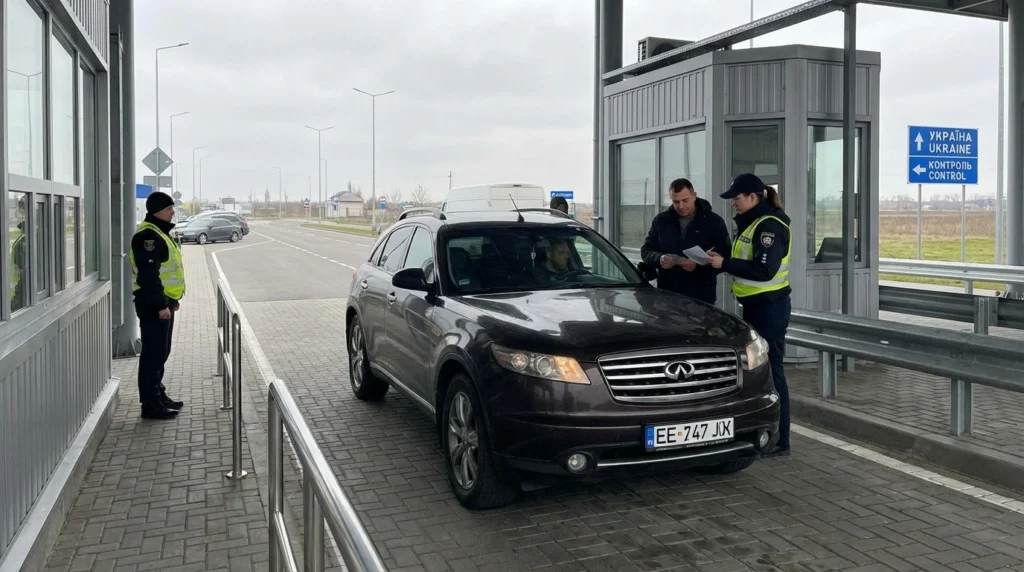
At the border: what officials usually verify
- Your identity and entry eligibility (passport/visa-free status, length of stay).
- Vehicle registration and whether you have the right to use the car (especially if you’re not the registered owner).
- Insurance (Green Card valid for Ukraine or Ukrainian CTP).
- Purpose of visit and where you’re going (a city name and approximate plan is enough).
Helpful phrasing: “Tourism, visiting Lviv and Kyiv for two weeks” or “Business meetings in Kyiv, returning on [date].” Avoid long stories; clarity reduces follow-up questions.
Roadside police checks: what they ask for in 2026
Police typically request the standard set:
- Driver’s license (and IDP if you have it)
- Vehicle registration
- Insurance policy (Green Card or Ukrainian CTP)
- Passport/ID may be requested in some situations
Typical questions: “Where are you going?”, “Who owns the car?”, “Do you have insurance?” If the car is not yours, expect: “Do you have authorization/power of attorney?”
How to respond safely and efficiently
- Keep documents together in a folder; hand over one at a time.
- Ask for clarification if you don’t understand: “Please repeat slowly” or “Can you show me what document you need?”
- Don’t offer cash to “solve” issues. If you believe a fine is incorrect, ask for the formal procedure and documentation.
- Record details (badge number, patrol car number) if a situation feels irregular.
Accident basics in Ukraine: what to do first and which numbers to call
After a crash, your priority is safety, medical help, and correct documentation—because insurance payments depend on how the accident is recorded.
Step-by-step checklist at the scene
- Stop and secure the area. Turn on hazard lights. Use a warning triangle if you have one.
- Check for injuries. If anyone is hurt, call emergency services immediately and do not move injured people unless there is immediate danger (fire, traffic risk).
- Call the right number (see below).
- Document everything: photos of vehicle positions, plates, damage close-up and wide shots, road signs, skid marks, and the overall scene.
- Exchange details: names, phone numbers, insurance info, vehicle registration data.
- Decide on police report vs Europrotocol (only if eligible).
- Notify your insurer as required by your policy terms and Ukrainian rules.
Emergency numbers to know
- 112 – general emergency number (works for police/ambulance/fire dispatch)
- 102 – police
- 103 – ambulance
- 101 – fire/rescue
Police report or Europrotocol?
Ukraine allows two main ways to formalize an accident:
- With police: recommended if there are injuries, disputes about fault, significant damage, more than two vehicles, suspected intoxication, or if you’re unsure about the other driver’s documents/insurance.
- Europrotocol: a simplified procedure used in limited situations (typically minor accidents with clear circumstances and proper documentation). If you’re a foreign driver and language is a barrier, involving police can be the safer route.
Direct settlement in 2026: if conditions are met, the victim may claim through their own insurer. This requires the accident to be properly recorded (police or Europrotocol) and other eligibility conditions to be satisfied.
What to avoid after an accident
- Leaving the scene before it’s properly documented (unless you must go for emergency medical help).
- Admitting fault on the spot in a way that contradicts later documentation. Stick to facts.
- Signing papers you don’t understand. Ask for translation or clarification.
Quick pre-departure checklist for driving into Ukraine
- Passport + visa/visa-free plan (know your allowed days)
- Driver’s license + IDP (recommended)
- Vehicle registration (original)
- Ownership proof and/or power of attorney (if not the owner)
- Valid Green Card for Ukraine or Ukrainian CTP purchased in advance
- Emergency numbers saved: 112, 102, 103, 101
- Phone camera storage cleared for accident photos